NORMANISM"... and on to New Zealand

    For some 30 years,Mac Leod and his group lived in the St.Anns
  area of Cape Breton, up along the coast from Indian Brook to
  Wreck Cove. A church was built,and the strict Presbyterian
  religion taught and insisted on by Norman,the difficulty of receiving

  proper ownership to their lands,the difficulty in farming the lands
  and the extreme climate of the area for 5-7 months made for an
 unhappy group.

   The potatoe crop in the late 1840's  was devasated  by blight and
 Mac Leod and many of the settlers bordered on starvation.


   Mac Leod's son had gone to AUSTRALIA, and in 1849, the son,Donald,
  wrote his father about the lushness of the land and the wonderful
  climate.... all year long. Keeping in mind that Rev.Norman was now
  in his 70's, his adventure to the other side of the world, makes
  this voyage all the more remarkable.

  In 1851, aboard the barque "MARGARET", Mac Leod and some of his
  followers started out for Australia and for the next couple of
  years, over 900 Cape Bretoners left the Island  on board the
  ships, "HIGHLAND LASS","GERTRUDE","SPRAY","Breadalbane", "Ellen
  Lewis".

  FAMILIES ON BOARD THE MARGARET

     Type of Vessel: Barque
     Tonnage: 236 tons
     Master: Captain Watson
     Place & Date of Departure: St. Ann's, Cape Breton, October 28th, 1851
     Place & Date of Arrival: Adelaide, South, Australia, April 10th, 1852

      HEAD OF FAMILY        # in family

      Hugh F. Anderson           1
      Donald Campbell            7
      Kenneth Dingwall           1
      Donald Finlayson           1
      John Fraser                7
      Donald MacGregor           8
      John McGregor              3
      Roderick Matheson          1
      Roderick McGregor          2
      James McGregor             3
      Hugh McInnes               1
      Alexander McInnes          1
      James McInnes               1
      John McKay                 14
      Roderick McHay, Jr.         3
      Martha McRae                7
      Roderick McKay, Sr.         11
      Donald MacLeod              9
      John D. McLeod
      George McLeod               3
      Rev. Norman McLeod          8
      John Kerr                   1
      Thomas McLeod               1
      John McLeod                10
      Donald Ross
      Roderick Ross
      Hector Sutherland           9
      Mrs. Watson & Family

   MORE REV.MAC LEOD REMEMBRANCES AND HISTORIC ARTICLES;

  From A History of the County of Pictou.Nova Scotia by Rev. George
Patterson, D.D. [Mika Studio Belleville, Ontario, 1972] reprinted from
edition published in 1877 by Dawson Brothers, Montreal.

Page 318-319:

But a person who at this time made more disturbance and excitement was
Norman McLeod, who arrived in Pictou about the year 1818.  He was not only
not connected with any religious body, but denounced them all, even going
so far as to say there was not a minister of Christ in the whole
establishment.  Those who have heard him at this time, describe his
preaching as consisting of torrents of abuse against all religious bodies,
and even against individuals, the like of which they had never heard, and
which were perfectly indescribable.  He had never been licensed or
ordained, but regarded himself as under higher influences than the
ministers of any church.  "I am so full of the Holy Ghost, that my coat
will not button on me," he said once in a sermon, as he made the attempt
to bring the two sides together in front.*

*He did not seem to be always so favored.  A gentleman told me that on one
occasion he went to where he was preaching in a barn.  As he passed the
open barn door, McLeod stopped and said, "as soon as I saw that man, the
Spirit refused me utterance."

But though so wildly fanatical, he was a man of great power, and gained an
influence over a large portion of the Highlanders, such as no man in the
county possessed.  As Dr. McGregor said, "he will get three hearers to Mr.
Fraser's one, and the people will go much further to hear him, than any
minister in Pictou."  He took up his residence at Middle River, and the
people of the upper part of the river, Lairg and neighborhood, who had
hitherto been under the ministry of Mr. Ross, generally followed him, so
that the latter relinquished to him his church at Middle River, which we
may remark stood at McKerr's intervale.  But his influence extended to
many in almost every part of the county, and by his followers he was
regarded with unbounded devotion.

After a time, however, a number became dissatisfied, when they found that
he would not give them baptism for their children.  Indeed during his
lifetime, he found very few whom he considered qualified to receive the
ordinance, and we are not certain if he found any to whom he would
administer the Lord's Supper.  He then induced a number of those over whom
he retained his influence, to emigrate, and for this purpose to build a
vessel at Middle River Point, which he called the Ark.  In this they left,
and afterwards formed the settlement of St. Anns, in Cape Breton.**  Many
in the county still remained his attached adherents, and were usually
known as Normanites, and almost as long as he remained in the Province,
when he visited Pictou they attended him wherever he went.  It is but just
to say, that these were regarded as among the most moral and religious of
our Highland population.

**At St. Anns he labored for many years, maintaining an unbounded sway
over his adherents, which was used in favor of temperance and sound
morality, but also we must say in nurturing a fanatical Pharisaism.  He
published a volume of some size, styled Normanism, besides minor
publications.  When an old man, he induced a number of his people again to
emigrate, and for this purpose to build a vessel.  In this they proceeded
to Australia, and thence to New Zealand, where he died.
==================
>>From Cape Breton Ships and Men by John P. Parker, M.B.E. Master Mariner
[Hazell Watson & Viney, Ltd. Aylesbury, Buckinghamshire, 1967]

page 55:
The [Barque] Ellen Lewis of 336 tones was launched in 1855 [in North
Sydney] and had involved transactions owing to the death of the owner,
George Lewis of North Sydney.  The barque was in the usual trades and Mr.
Lewis was authorized by his creditors and co-owners to sell the vessel
abroad in 1857 for not less than £3,000.  He died in 1858 and English
agents were given authority to sell.  This was not done and the barque was
brought back.  The administrators of the estate were Robert Boak and
Bernard O'Neill and they sold the barque to William Ross, John Munro and
Donald McKenzie, all Cape Bretoners, who sold space to the remaining
followers of the Rev. Norman McLeod.  The vessel sailed from St. Ann's on
the 17th of December, 1859, and arrived at Auckland on May 14th, 1860,
with 188 passengers.  The master on this voyage appears to have been
Donald McKenzie and he was given authority to sell the vessel in New
Zealand.  This was not done at this time and other people became involved
until August, 1861, when the barque was sold and registered at Sydney,
Australia

page 61:
In 1829 John Munro of St. Ann's, where the followers of the Rev. Norman
McLeod were now well established, had the small schooner Isabella of 43
tons built at Baddeck.

page 66:
The Bradelbane of 224 tons was the largest and best vessel ever built at
Baddeck.  In 1854 this barque was launched by John Moffatt for C. J.
Campbell.  She was so-called because the owner was descended from the clan
Campbell of Bradelbane, Scotland.  The barque was much more elaborate than
others of her period.  She was launched with considerable ceremony with
Mrs. Campbell breaking a bottle of wine on her bow and in the evening a
reception was held to celebrate the event. The vessel had a long poop
deck, quarter galleries and is said to have been constructed off a block
model obtained from the celebrated Napier who was a leading marine
architect in the United Kingdom.  She was a very superior little barque
with many of her fittings imported from Glasgow.  The first three years of
her life, under Captain Charles Florian, are not clear but it is reported
that Mr. Campbell went on the maiden voyage to Scotland where it is quite
possible that many of the refinements were carried out.  She probably
carried a timber cargo from Baddeck.  The painting of this vessel shown
here was kindly provided by the Alexander Turnbull Library of Wellington,
N.Z., and shows she was complete with top-gallants and royals.  The
decoration at the bow is not clear but she probably had a scroll and not
any figurehead.  In the Cape Breton News of March 4th, 1854, an
advertisement appeared offering passage from Scotland to Canada but the
cost of the fare is not included.  This undoubtedly was for the benefit of
well-to-do Cape Bretoners who could bring out less fortunate relatives or
friends who still lived in Scotland.

The details of this barque are not clear.  In 1857 she was purchased by
parties who sold space to those people who wished to follow the Rev.
Norman McLeod to New Zealand.  In any case the Bredalbane sailed from Big
Bras d'Or on December 26th, 1857, with 129 passengers for Auckland, N.Z.,
and arrived there on May 23rd, 1858.  I assume that the barque was sold
there but no further transactions are carried on her register.

page 69:
The brigantine Spray of 107 tons was the smallest of the vessels and
fourth to sail with the followers of the Rev. Norman McLeod on their
voyage to New Zealand.  She had been built at Guysborough in 1851 and
following some misadventure was purchased by John Ormiston of Gabarous in
1853.  On March 7th, 1856, he sold the brigantine to Angus Matheson of
Baddeck who held half the shares, the remainder being owned by C. Stewart,
Alex Stewart and Archibald Stewart, all of Big Harbour.  Captain John
Duncan was master and he had 66 passengers, but one, a child, died en
route and four were born.  A list of the people who made the passage in
these vessels is contained in a small book named Idyall of the
Shipbuilders by G. McLeod.  The Spray sailed from Big Bras d'Or on January
13th, 1857, and arrived at Adelaide on Jun 25th.  Again it is remarkable
about the consistency of the voyages made by the six vessels from Cape
Breton.  All took about five or six months and all were quite different in
size and rig.  Only very few people died on the voyages, not more than
would have died among a group of people of the same size had they remained
at home.  This indicates they were well provisioned, well organized and
the ships well handled.

Of the six vessels used by these people in their great adventure, four
were built in Cape Breton and one, the Gertrude, was a new Prince Edward
Island brig that had been stranded at St. Ann's and bought by local
people.  The sketch shown here of the sixth, the Spray, was done by John
Alexander Munro.  As he was not born until 1872 and died in 1947 the
sketches were done from descriptions given by the older people.  The
Bradelbane photograph is from a painting.

[Note:  I can not find the pictures referred to in the text.  They do not
appear to be in this edition of Parker's book.]

page 120
In 1820 a party arrived [at St. Ann's] in the small vessel Ark.  They were
led by the Rev. Norman McLeod and at the time were attempting to sail from
Pictou, N.S., to Ohio via the New England coast.   This may sound
roundabout to our ears but it was quite feasible and included a journey
from the Atlantic coast across the mountains to the recently opened
central parts of the United States.

The Ark had sailed from Pictou but had encountered a storm and blown far
off course.  when the weather moderated they found that they could make
into St. Ann's, so they came past the bar and anchored.  It was a
beautiful clear day after the storm and the rugged scenery was somewhat
reminiscent of their old home in Scotland.  The dense forest came down to
the water's edge and there was every indication that fishing prospects
were very good.  Land grants were obtained and the new settler s took
possession of their land and went to work.

The story of these people does not concern us here except in the ships
they built and the use they made of them.  Soon after their arrival when
the houses had been built, some land cleared and the crops sown, they
began to construct  small boats and vessels for fishing and trading.

The Rev. Norman McLeod was the leader of most but not all of the people at
St. Ann's and the neighbouring communities.  He had tremendous influence
over many of them and they looked upon him as their spiritual adviser and
also as an instructor in their daily life and problems.

page 122:
As many of the sons of the settlers became seamen it was their custom to
sail in the ships on foreign voyages.  In this case Donald McLeod sailed
in the small schooner Maria which had been completed at Big Bras d'Or in
1840.  This schooner was delivered in the United Kingdom and Donald then
shipped out on another ship and eventually arrived in Australia.  From
there he wrote a glowing account of the country to his father, Rev. Norman
McLeod, and suggested that a better life might be had by the people of St.
Ann's and vicinity.

Although Norman McLeod was at this time approaching seventy years of age
and his wife was not well, great thought and prayers were given to the
idea of building a vessel and sailing around to the other side of the
world.  The thought of another potato blight and the hard winters of Cape
Breton swayed the settlers and it was decided to emigrate.

For this purpose the small barque Margaret of 236 tons was constructed
under the direction of Neil McGregor.  She was fitted with a female
figurehead resembling the daughter of the Rev. Norman McLeod and the
barque was named after her.  It would appear that the timber for this
barque was cut of the McLeod property, a great deal of the labour was
supplied free by the men of the community so until the time came to buy
sails, cordage and fittings the cash outlay was not great.  At about this
time a buyer was found for the McLeod property and the necessary cash was
forthcoming.  On October 14th, 1851, all shares in the barque were
registered in the name of Norman McLeod.  On the same day he transferred
all 64 shares to Mr. T. D. Archibald for a loan of £200 sterling.  To
finish up the business details the vessel was sold in Australia and the
sale was handled by a representative of Mr. Archibald who thus regained
his loan.  Mr. George Elder of Adelaide, Australia, then advanced the sum
of £1,250 19s. 3d. with interest at the rate of 10 percent per annum with
the vessel as security for this and also for any further sums that Mr.
Elder might advance.  As vessels like the Margaret regularly cost about
£12 per ton it seen [sic] that her value was about £3,000 less
depreciation for one year.  Norman McLeod was thus assured of a large sum
of money to pay the expenses of his people for a considerable period.

To go back, the Margaret sailed from St. Ann's on October 28th, 1851, with
130 passengers and arrived at Auckland on April 10th, 1852, having called
at Cape Verde and Cape Town.  It is understood that Norman McLeod and his
band, together with the additions brought out by the Highland Lassie later
that year, remained in Australia for about two years before going on to
New Zealand.  But that is another story.  The Margaret was sold to
Australian owners and disappeared from our knowledge.  In all six vessels
took the Canadian contingent away and we will deal with them as they occur
in the records.
============================
>>From Wooden Ships and Iron Men by Frederick William Wallace [Mika
Publishing Company, Belleville, Ontario, 1976] reprint of edition
published by Charles E. Lauriat Co. Boston, 1937.

pages 80-81:
During the 'fifties a number of Nova Scotians of Scottish birth or
ancestry emigrated to New Zealand in vessels which they built themselves.
The district of Waipu. on the east coast of the North Island of New
Zealand, and about 75 miles north of Auckland, was settled by emigrants
from Nova Scotia.  The vessels which brought the settlers from Canada to
the South Pacific colony were as follows:  barque Margaret, 236 tons,
sailed in 1851 via Adelaide and arrived New Zealand in 1852; brig Highland
Lassie, 179 tons, arrived New Zealand in 1852; brig Gertrude, 217 tons,
arrived  1856; brigantine Spray, 99 tons, arrived 1857; barque Breadlbane,
250 tons, arrived 1858; barque Ellen Lewis, 336 tons, arrived in 1860.

The Rev. Norman McLeod, formerly of Pictou, N.S., built the Margaret at
St. Ann's, Victoria County, Cape Breton, and sail in her for Australia and
New Zealand back in the 'fifties.

The Carleton (St. John, N.B.) Sentinel, of Jun, 1856, ran the following
advertisement regarding sailings for New Zealand: "For New Zealand, should
sufficient inducement offer, a vessel will be laid on berth for the above
islands to sail in August next.  For terms of freight and passage apply to
Stewart and McLean, Ship-brokers, St. John."

The brig Gertrude, mentioned above, sailed from Cape Breton on June 25th,
1856, via the Cape of Good Hope and Sydney, and arrived at Auckland on
December 17th.  She had 190 passengers, a woman and child dying on the
voyage.  There was some scurvy among the emigrants, who were met by
relatives who had arrived in New Zealand previously.  The Gertrude's owner
and family were on board.

The Wellington Independent of December 10th, 1868, published the following
item:

"We are informed by Capt. Scott, the inward pilot, that the brigantine
which has been for the last three or four days anchored off the Heads has
proceeded to Otago.  Her name is the Emulous, Capt. Cumminger, from
Halifax, N.S.  There are 53 passengers on board, and the vessel is owned
by the captain and 11 others.  All on board, with their wives and
families, came out to settle in New Zealand.  They had very fair passage
of 103 days to Auckland Heads."

It appears that when the emigrants sailed from Nova Scotia they had no
definite idea as to what part of New Zealand they would settle in, and
only decided on Otago when laying wind-bound off the Heads.

pages 334-336:
In 1817 there came to Pictou, N.S., the Rev. Norman McLeod with a
following of coreligionists from Assynt, Scotland.  McLeod was a man of
pronounced views regarding religion, an exacting Presbyterian, and to his
followers he was preacher, teacher, leader and patriarch.  In 1819, he
received a call from a settlement of Highlanders in Ohio to come and be
their minister.  He accepted the invitation, but being loath to abandon
his attached followers in Pictou, he decided to take them with him.  The
problem of making the journey to Ohio was debated, and it was finally
decided to there by water via the Gulf of Mexico and the Mississippi
River.  Accordingly, and with characteristic energy, McLeod began the
construction of a vessel large enough to carry the emigrants and their
effects, and the keel of this craft was laid at Middle River Point,
Pictou, in the summer of 1819.  The people of Pictou regarded the project
with derision, and nick-named the vessel the "Ark."  The Ark was launched
in the spring of 1820, and in May she took her passenger s aboard and set
sail for the Gulf of Mexico.  After passing through the Straits of Canso,
the Ark met a heavy S.W. gale, which drove her up the Cape Breton coast. A
shift of wind sent the vessel into St. Ann's harbour, Cape Breton, and
they dropped anchor there.  Their experiences during the gale sickened the
emigrants of the Ohio idea, and they decided to settle in St. Ann's.  Land
was granted to Mr. McLeod, and a community sprang up around the minister's
residence at Black Cove.

McLeod remained ministering to his flock amidst the Cape Breton hills,
working with them in their daily labours and ruling them with a rod of
iron.  In 1847, the minister received a letter from his son Donald, who
had settled in Adelaide, Australia.  Donald McLeod was a ship-master who
had left St. Ann's eight years before in charge of a vessel built there.
He took the craft to Glasgow, sold her there, and after remitting the
proceeds, dropped out of sight until news of him came in his letter.  In
this epistle, Donald told of the mild climate of Australia, the natural
resources and wonderful opportunities awaiting settlers.

A failure of the potato crop inspired McLeod and his flock with the idea
of making a shift to Australia.  Though 70 years of age at the time, the
minister caused the keel of a barque to be laid, and the work of building
her was undertaken by the congregation.  In 1851, the barque Margaret, 236
tons, was launched and rigged, and on October 28th, 1851, she sailed out
of St. Ann's Harbour bound for Adelaide, with the Rev. Mr. McLeod and 135
emigrants on board.  A call was made at St. Jajo, Cape Verde Islands, and
also at Cape Town, for the replenishing of supplies.  On April 10th, 1852,
the Margaret arrived at Adelaide, after a voyage of 164 days.

South Australia proved a disappointment to the emigrants.  It was not
suitable for farming owing to the severe droughts, so in 1854, McLeod and
his people migrated to New Zealand, and finally settled in the district of
Waipu, where they found all that their hearts desired.  Urgent calls to
come out to New Zealand were sent to those who had remained in St. Ann's,
and in response to these invitations some 750 persons left Cape Breton and
joined the Waipu colony, making the voyage to New Zealand in vessels built
by themselves.

Norman McLeod passed away in the midst of his followers in March, 1866,
aged 86 years.  He was a man of great physical strength, strong mentally
and spriritually, and he wielded a tremendous influence over his people.
His name is greatly honoured in the Waipu settlement, and a splendid
monument was erected in 1914 at Waipu to the memory of McLeod and those
who followed him.

Any in New Zealand the seafaring instinct that entered their blood through
their sojourn in Nova Scotia inspired them to build sailing ships and
boats and to engage in fishing and ocean trading, causing it to be said in
after years "that Waipu sent out, for its size, more sea-captains than any
other community in New Zealand."

The other vessels which participated in the migration were the Highland
Lassie, Gertrude, Spray, Breadalbane and Ellen Lewis.


                 Breadalbane arrived Dec 1858, under Captain Jones of
 Sydney; ; Flower, Fergusson; Fraser; Lewis; Henderson; Holmes;
Hatfield; Johey; McCauley; McDonald; McFarlane; McInnes; McKay;
McKenzie; McLean; McLennan; McLeod; Morrison;
Munroe; Stuart; Sutherland:
(There were 129 passengers on this vessel, bound for Waipu)


   In 1853, the "Gazelle" arrived in AUKLAND,New Zealand with the
  first group of Cape BretonersThe Rev.Mac Leod was not a passenger
  on this trip. Shortly after their arrival,DUNCAN MAC KENZIE
  and DUNCAN MAC KAY from the ship "Highland Lass", met with
Sir George Grey,Governor of New Zealand, in the hopes of receiving
  land grants. WAIPU was the desired area, and flocks of former
  CAPE BRETONERS began to arrive...

               and REMAINED TO THIS DAY  ....

        BUT  FIRST.....WHY  DID  MAC  LEOD  AND OVER 900  OF
    HIS FAITHFUL, LEAVE CAPE BRETON AND TAKE ON A MOST DANGEROUS
    VOYAGE TO THE OTHER END OF THE EARTH ???

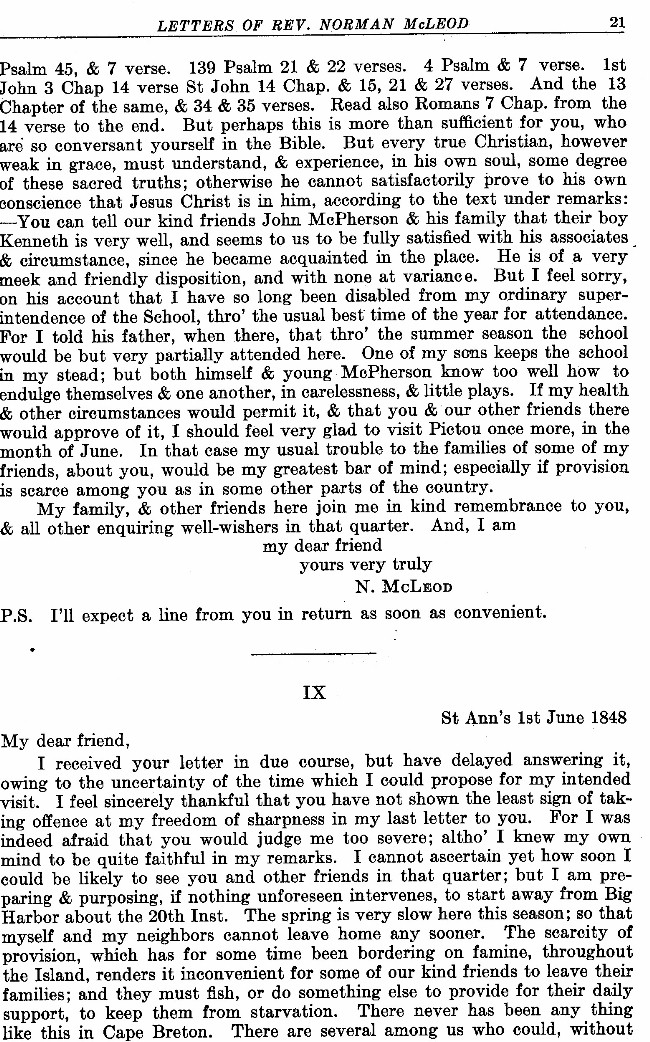
        BELOW ARE A COUPLE OF LETTERS MAC LEOD WROTE TO A FRIEND. In
    THOSE LETTERS WE MAY UNDERSTAND THEIR RECKLESSNESS AND
        FAITHFULLNESS TO MAC LEOD.


      BOTTOM PICTURE .....   The  "House of memories"  located
                               in WAIPU, NEW  ZEALAND

                     GO  TO THEIR  SITE  IN THE LINKS BELOW